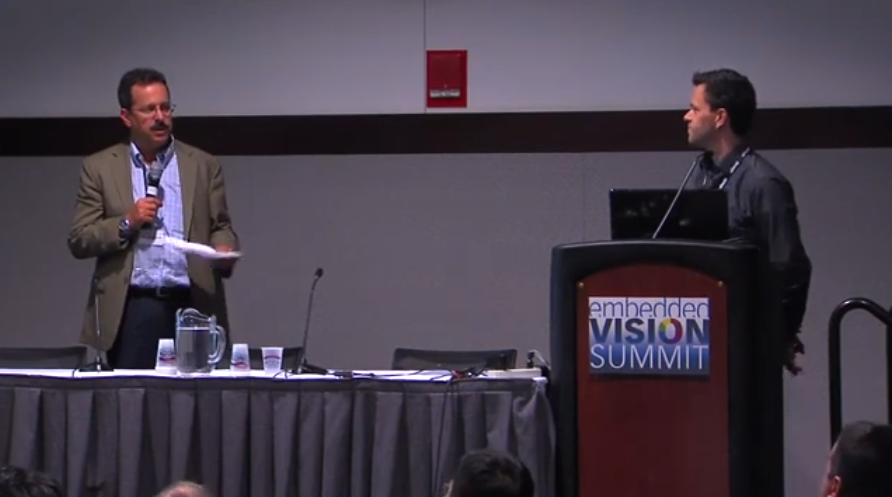
If you ever presented at the Embedded Vision Summit, you have met Jeff Bier.
As founder of the conference, he remains deeply committed and involved in every aspect of the event. The rite of passage for each presenter is an exhaustive review with Jeff Bier. When I say exhaustive, I mean exhaustive. Starting with the slide template, every slide, every word, every font is scrutinized. Beyond that, the content is intensely reviewed to ensure that attendees are not watching a commercial, but actually learning something insightful.
For each of my presentations, the drafts I arrived with came out of the review meaningfully restructured, each time with a stronger emphasis towards real applications and benchmarks when possible.
I went through this ritual three times:
- 2012 - Addressing System Design Challenges in Embedded Vision
- 2013 - Targeting Computer Vision Algorithms to Embedded Hardware
- 2015 - System-Level Design for Embedded Vision with FPGA-based Programmable SoCs
Actually four times, since my 2013 talk on Targeting Computer Vision Algorithms, which had my highest attendee review score, was delivered twice. This did not exclude it from getting an exhaustive review, which seemed even more intense the second time.
I think the reason this presentation got higher reviews than the others was that it did have a lot of numbers (not real benchmarks, but paper napkin calculations) and considered solutions from more than one vendor (ADI’s BlackFin processor, and XILINX’s Zynq-7000 SoC).
For the second revision of the 2013 presentation, I was starting to get seriously discouraged. I could not meaningfully discuss an application I had not actually explored, nor could I invent benchmarks which were not taken. I had to be creative and work with what I had accomplished. Jeff simply replied “Bird by Bird”.
I did not know that reference, so he had to describe Anne Lamott’s excellent book to me. It made sense to concentrate and execute on incremental improvements, instead of getting overwhelmed by the scale of what was being created.
The experience I acquired during these reviews brought me to see my work in a new light. I started anticipating what may be needed for future presentations. I took the time to carefully capture metrics, document my process, and imagine which applications would make use of the algorithms I was exploring.
More than a decade later, I found myself without a permanent job, wondering what could be my next chapter.
Knowing that there is no such thing as a permanent job, I spent the last two years writing technical content, continually trying to de-mystify algorithms and applications, while reporting on how to reproduce my experiments and benchmarks. I was preparing the path for a possible career as a technical writer. What I didn’t expect was the visibility and credibility these articles would be providing me.
Turns out, Jeff steered me on a path of benchmarking and reporting. In fact, most of the interest for contract opportunities that I am receiving gravitates around this theme.
Reading BDTI’s foundational benchmarking papers more recently has been like discovering, in print, the discipline Jeff was teaching me thirteen years ago: The Art of Processor Benchmarking, Evaluating DSP Processor Performance, The BDTImark2000™: A Summary Measure of DSP Speed.
So I find myself taking on the unimaginable task of benchmarking Edge AI accelerators, independently, objectively.
Bird by Bird.